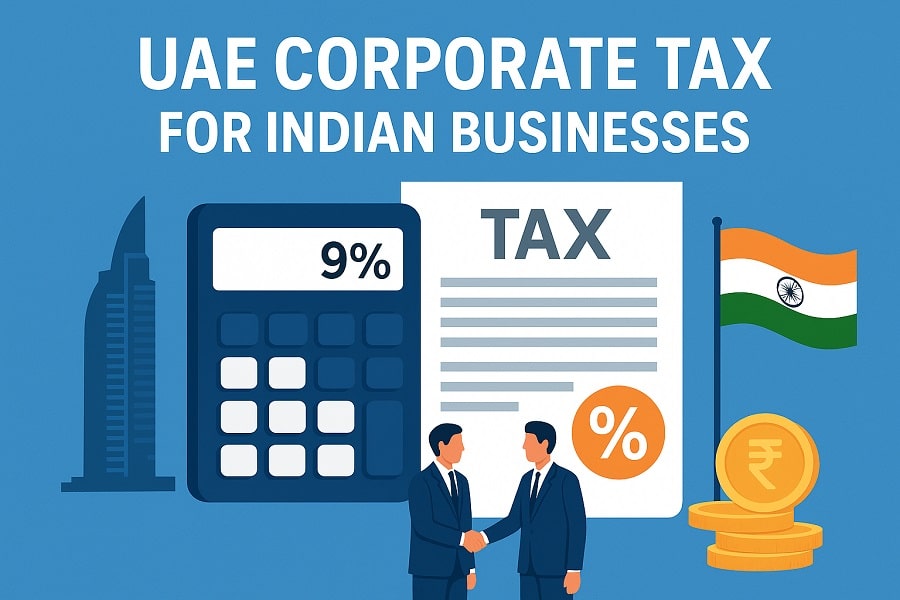
Why UAE’s Corporate Tax Is Good News for Indian Businesses
For years, setting up a company in the UAE was almost synonymous with speed, global access, and near-zero corporate taxes. While speed and connectivity remain unchanged, the tax landscape has evolved — and that change is proving to be a positive development for serious Indian businesses looking to scale sustainably.
The introduction of a 9% UAE corporate tax marks a shift from perception-driven advantages to credibility-driven growth. Far from discouraging investment, the move strengthens the UAE’s position as a mature, globally respected business hub.
UAE Corporate Tax: What Has Changed?
The UAE introduced corporate tax for financial years starting on or after 1 June 2023. Under the new framework:
- 0% tax applies on taxable profits up to AED 375,000
- 9% tax applies on profits above that threshold
While no longer “tax-free,” the UAE remains one of the most competitive jurisdictions globally. More importantly, the country now expects businesses to demonstrate real economic substance, supported by audited financials and proper governance — not just impressive presentations.
Why This Is a Positive Shift for Indian Companies
A clearly defined corporate tax regime enhances the UAE’s credibility in an era of heightened global scrutiny. With tighter banking norms, investor due diligence, and OECD-led anti-avoidance measures, predictable taxation removes the “tax haven” label.
For Indian businesses raising international capital, serving regulated clients, or expanding globally, this added credibility is a strategic advantage — not a drawback.
The new regime also encourages stronger financial discipline, better documentation, transparent board practices, and structured compliance — all essential traits for long-term growth.
Free Zones: Still Attractive, but No Longer a Free-for-All
One common misconception needs to be addressed: free zone no longer automatically means 0% tax.
A free zone company can enjoy a 0% corporate tax rate only if it qualifies as a Qualifying Free Zone Person (QFZP). This status requires:
- Adequate physical and operational substance in the free zone
- Audited financial statements
- Transfer pricing compliance with proper documentation
- Non-qualifying income limited to the lower of AED 5 million or 5% of total revenue
Failure to meet these conditions can result in the loss of QFZP status — not just for the current year, but for up to five consecutive tax periods.
That said, the rules are clearly defined. Qualifying activities include manufacturing, logistics, treasury and financing services to group companies, and distribution from designated zones. This benefits businesses building genuine regional platforms rather than paper entities.
Mainland vs Free Zone: Choosing the Right Structure
- Mainland companies are better suited for businesses serving the UAE domestic market with local customers, contracts, and delivery.
- Free zone companies work best as regional hubs for exports, re-exports, group services, and cross-border operations — provided compliance requirements are met.
Trying to operate a mainland-style business through a free zone structure often leads to tax inefficiencies and regulatory risks.
Compliance Is No Longer Optional
The UAE Federal Tax Authority (FTA) has introduced strict timelines:
- Corporate tax registration is generally expected within three months of incorporation
- Late registration can attract penalties of AED 10,000
- All entities — including free zone companies — must register and file returns
- Tax returns are due within nine months of the financial year-end
- QFZPs must maintain and submit audited financial statements
The era of relaxed timelines has ended. Structured compliance is now a core business requirement.
Large Indian Groups and the Global Minimum Tax
For multinational groups, the UAE is aligning with the OECD’s Pillar Two framework through a Domestic Minimum Top-up Tax (DMTT).
Effective for financial years starting 1 January 2025, this applies to UAE entities that are part of multinational groups with global revenues of €750 million or more.
For large Indian conglomerates, this shifts focus from short-term tax planning to fundamental questions: where value is created, where talent is located, and how UAE operations fit into the global structure.
What Indian Businesses Should Consider Before Setting Up in the UAE
- Clarify the purpose: regional hub, exports, holding company, treasury, or UAE domestic operations
- Build substance from day one: decision-making authority, key employees, and contract execution matter
- Maintain strong transfer pricing practices for intercompany services, IP, and financing
- Monitor qualifying income thresholds closely if operating in free zones
- Run the UAE entity professionally with a clear compliance calendar and robust documentation